
The total head of a pump is one of the most important parameters to know before purchasing the system. It is an extremely technical piece of data, calculated in a complex way, but it indicates whether that type of pump is suitable for your needs. Alternatively, you might end up with a pump that cannot work as required, wasting money and time.
In recent years, technological innovation has led to significant improvements in pump performance. Today, they are much more reliable and versatile than in the past. We at CDR Pompe we always work striving for the highest quality and the greatest possible efficiency, and we can also guide you in making the best choice for your pump in the field of industrial, but also chemical and pharmaceutical.
In this article, we want to talk to you about total head, a type of parameter that you might not be familiar with. We will try to explain what it is, how it is calculated, and why it is essential to know it.
Let's understand what pump total head means.
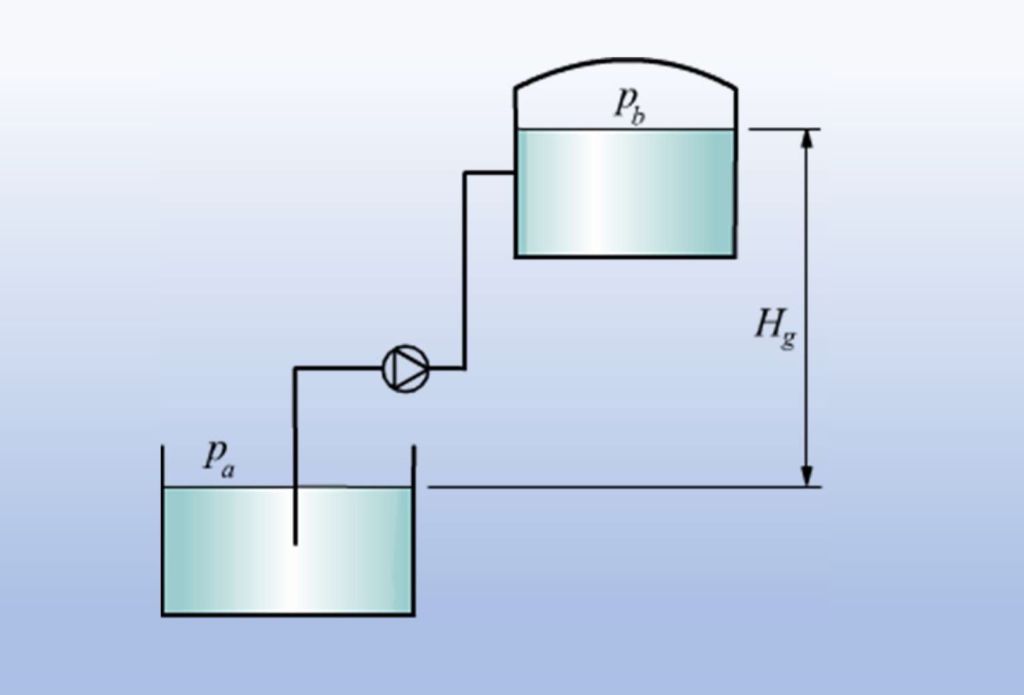
Total Head is a very important physical quantity that indicates the maximum height a pump can lift a fluid. In most common measurements, it is expressed in meters. Essentially, total head refers to the pump’s ability to overcome the difference in elevation between the suction point (the area from which the liquid enters the pump) and the discharge point (the outlet area or flange where the fluid exits the volute), taking into account pressure losses caused by friction and other specific resistances that may be present in the system.
We could also define total head of a pump using other words, such as the energy per unit mass supplied by the pump to a fluid.
Total head is calculated as the sum of the static head and the head losses, and it is essential to ensure that a pump is adequate for the specific needs of a system.
An insufficiently high total head value can also cause malfunctions. Consequently, it is essential to know this value at the time of purchase. In summary, total head is a key indicator of a pump's operational efficiency in fluid transfer in various industrial and non-industrial application contexts.
How is total head calculated
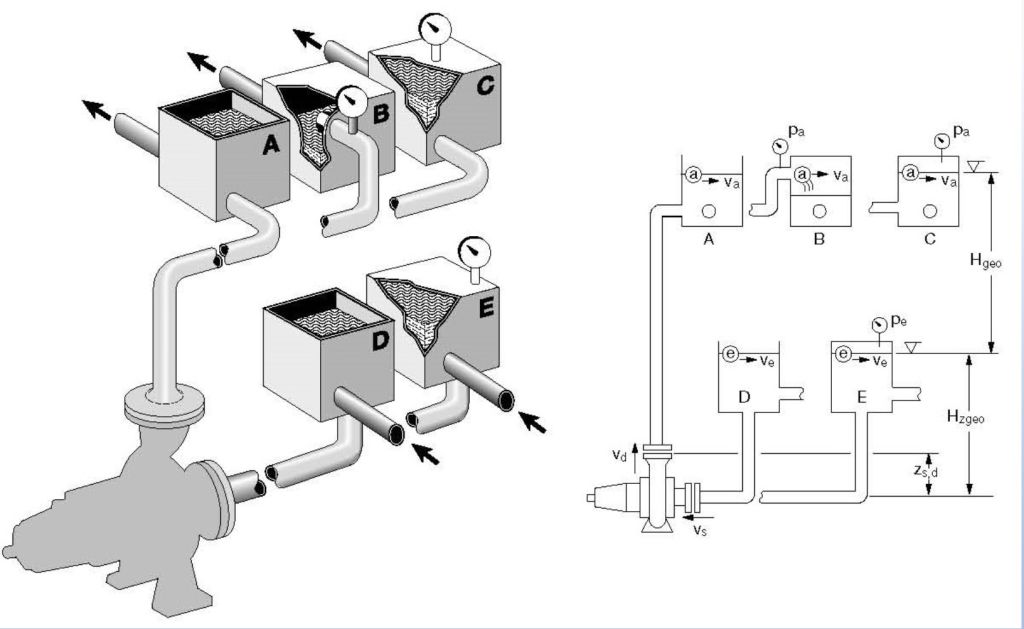
The formula for calculating the total head is as follows: H = Hgeo + (Pa-Pe)/g + (va^2 - ve^2)/2g + Hv. We will now explain the individual elements of the equation.
- H: it is the total head of a pump, it is expressed in meters;
- Hgeogeodetic head between the free surface of the reservoir and the pump suction
- Dadatmospheric pressure;
- Peppertank pressure;
- P: fluid density;
- ggravitational acceleration constant 9.81 m/s2
- Gofluid velocity at suction and discharge;
- Whatcircuit pressure drops.
On a mathematical level, The total head of a pump is inversely proportional to the pump's flow rate.. The flow rate is nothing more than the quantity of fluid (or volume) that passes through the pump per unit of time. Therefore, the greater the pump's flow rate, the lower its total head will be.
The total head data can be obtained through relatively simple calculations. Ultimately, all that is needed is knowledge of the physical characteristics of the fluid and the pump. Alternatively, plant data can also be used. Specifically, we are talking about head losses, elevation difference, or pressure.
Total Head is a fundamental data point for purchasing a pump
Before purchasing any type of pump, magnetic drive pumps and mechanical seal pumps, Knowing the total head's value is really important. Different models have different total head. Even seemingly identical models may have specifications that do not match the desired ones.
The total head data is available, in most cases, in the product data sheet. It is therefore not a hidden piece of data, or one to be calculated independently. It must, in fact, be freely available for the customer to consult at the time of purchase.
A fundamental piece of advice, therefore, is to Never buy a pump if you don't know its total head, or worse, if this value is fraudulently hidden.
For over 70 years, we at CDR Pompe We stand with companies like leader in fluid technology. With passion, experience, and constant innovation, we aim to deliver devices for handling corrosive liquids that operate with complete safety and reliability.
Our business activities are distributed in over 50 countries. Today, we are national and international leaders with a distribution network and partners that allow us to operate anywhere with full efficiency.


