

TLDR
- It total head indicates the maximum height to which a pump lifts a fluid; it is expressed in meters and includes the elevation difference and load losses.
- It is calculated by adding total head geodetic, pressure difference, speed difference and load losses of the circuit, with g equal to 9.81 m/s².
- Using the formula H (m) = P (bar) × 10.197 / γ, 3 bars are equivalent to 30.6 m for water and 16.6 m for 98% sulfuric acid.
- At the same viscosity, the total head in-meter change does not change with the density, while the absorbed power at the axis increases in proportion to the specific weight.
- The value of total head is shown in the technical sheet and should be verified before purchase, because seemingly identical models can have different specifications.
Index
The total head of a pump is one of the most important parameters to know before purchasing the system. It is an extremely technical piece of data, calculated in a complex way, but it indicates whether that type of pump is suitable for your needs. Alternatively, you might end up with a pump that cannot work as required, wasting money and time.
In recent years, technological innovation has led to significant improvements in pump performance. Today, they are much more reliable and versatile than in the past. We at CDR Pompe we always work striving for the highest quality and the greatest possible efficiency, and we can also guide you in making the best choice for your pump in the field of industrial, but also chemical e pharmaceutical.
In this article, we want to talk to you about total head, a type of parameter that you might not be familiar with. We will try to explain what it is, how it is calculated, and why it is essential to know it.
Let's understand what pump total head means.
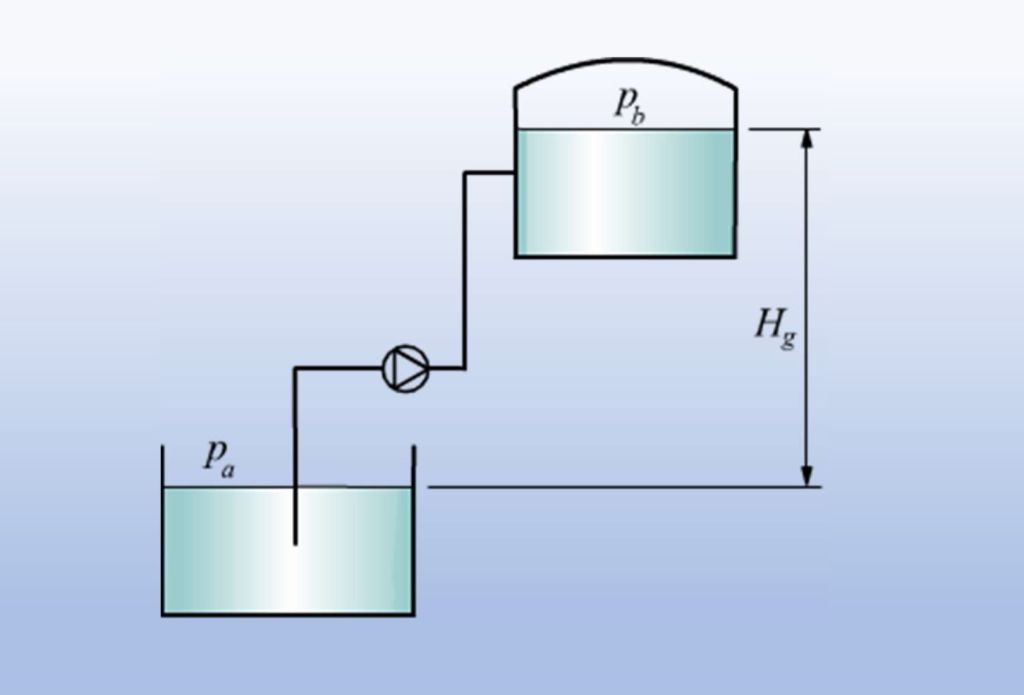
Total Head is a very important physical quantity that indicates the maximum height a pump can lift a fluid. In most common measurements, it is expressed in meters. Essentially, total head refers to the pump’s ability to overcome the difference in elevation between the suction point (the area from which the liquid enters the pump) and the discharge point (the outlet area or flange where the fluid exits the volute), taking into account pressure losses caused by friction and other specific resistances that may be present in the system.
We could also define total head of a pump using other words, such as the energy per unit mass supplied by the pump to a fluid.
Total head is calculated as the sum of the static head and the head losses, and it is essential to ensure that a pump is adequate for the specific needs of a system.
An insufficiently high total head value can also cause malfunctions. Consequently, it is essential to know this value at the time of purchase. In summary, total head is a key indicator of a pump's operational efficiency in fluid transfer in various industrial and non-industrial application contexts.
How is the calculation of the total head
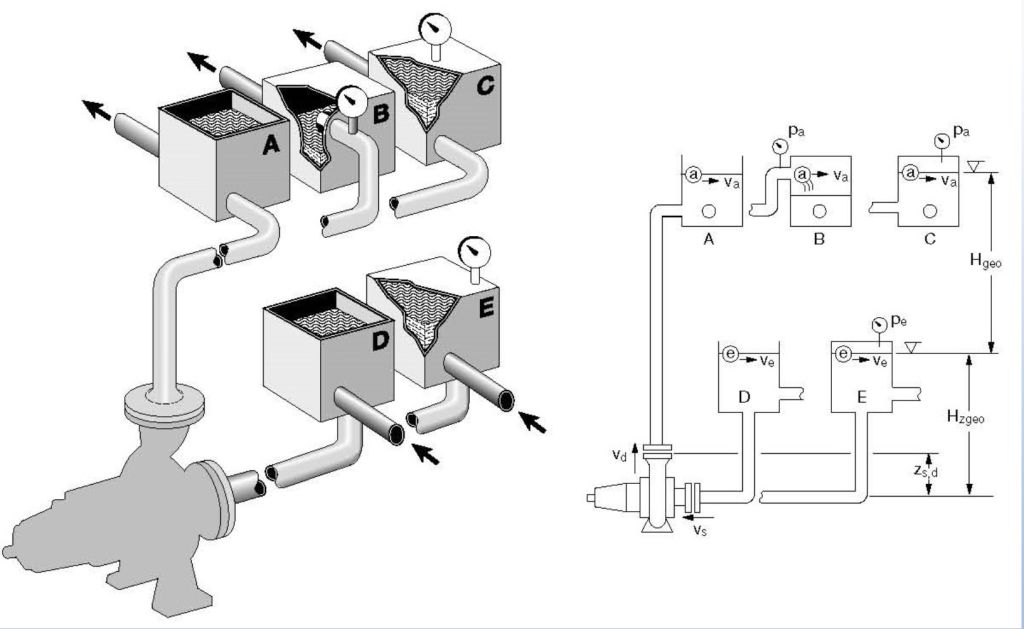
The formula for calculating the total head is as follows: H = Hgeo + (Pa-Pe)/g + (va^2 - ve^2)/2g + Hv. We will now explain the individual elements of the equation.
- H: it is the total head of a pump, it is expressed in meters;
- Hgeogeodetic head between the free surface of the reservoir and the pump suction
- Dadatmospheric pressure;
- Peppertank pressure;
- p: fluid density;
- ggravitational acceleration constant 9.81 m/s2
- Gofluid velocity at suction and discharge;
- Whatcircuit pressure drops.
On a mathematical level, The total head of a pump is inversely proportional to the pump's flow rate.. The flow rate is nothing more than the quantity of fluid (or volume) that passes through the pump per unit of time. Therefore, the greater the pump's flow rate, the lower its total head will be.
The total head data can be obtained through relatively simple calculations. Ultimately, all that is needed is knowledge of the physical characteristics of the fluid and the pump. Alternatively, plant data can also be used. Specifically, we are talking about head losses, elevation difference, or pressure.
Quick calculation table: conversion between pressure (bar) and total head (meters) based on the fluid density
In pumping industrial and chemical, one of the most common errors consists in confusing the manometric pressure (in bar) with the total head geodetic and manometric (in meters of liquid column, m.c.l.). Since H (m) = (P [bar] × 10.197) / γ (where γ It is the specific weight or relative density of the fluid in kg/dm³), at the total head same meters a pump that moves a heavy acid develops a pressure in bars much higher than that of water:
| Pushed fluid (application example) | Specific gravity γ (kg/dm³) | Total Head 20 m → Pressure (bar) | Total Head 40 m → Pressure (bar) | Pressure 3 bar → Total Head request (m) |
|---|---|---|---|---|
| Organic solvents / light hydrocarbons | 0.80 kg/dm³ | 1.57 bar | 3.14 bar | 38,2 m |
| Water industrial (20 °C) | 1.00 kg/dm³ | 1.96 bar | 3.92 bar | 30,6 m |
| Caustic soda (NaOH at 30%) / salt | 1.33 kg/dm³ | 2.61 bar | 5.22 bar | 23,0 m |
| Concentrated sulfuric acid (H₂SO₄ at 98%) | 1.84 kg/dm³ | 3.61 bar | 7.22 bar | 16,6 m |
Technical note for sizing: while the reading total head in meters (H) on the characteristic curve of the centrifugal pump remains unchanged as the fluid density varies (at the same viscosity), the Power absorbed at the axis (kW) It grows in a directly proportional way to the specific weight γ, requiring a precise verification of the electric motor and of the magnetic joint if present.
Total Head is a fundamental data point for purchasing a pump
Before purchasing any type of pump, magnetic drive pumps and mechanical seal pumps, Knowing the total head's value is really important. Different models have different total head. Even seemingly identical models may have specifications that do not match the desired ones.
The total head data is available, in most cases, in the product data sheet. It is therefore not a hidden fact, or one that has to be calculated independently. It must in fact be freely accessible to the customer at the time of purchase and thereafter. correct sizing of the centrifugal pump.
A fundamental piece of advice, therefore, is to Never buy a pump if you don't know its total head, or worse, if this value is fraudulently hidden.
For over 70 years, we at CDR Pompe We stand with companies like leader in fluid technology. With passion, experience and constant innovation, we aim to deliver handling devices for corrosive liquids that act with the utmost security and reliability.
Our business activities are distributed in over 50 countries. Today, we are national and international leaders with a distribution network and partners that allow us to operate anywhere with full efficiency.
Frequently Asked Questions
What is the power total head of a centrifugal pump and in what unit of measurement is it expressed?
This total head is the maximum height to which a pump can lift a fluid and is commonly expressed in meters. It indicates the ability to overcome the difference in elevation between the suction and discharge points, taking into account the load losses due to friction and the resistance of the system. It can also be defined as the energy per unit mass supplied to the fluid.
What is the formula for calculating the flow rate total head of a pump and what quantities does it include?
The total head H, in meters, is given by H = Hgeo + (Pa-Pe)/(ρ·g) + (va²-ve²)/2g + Hv. It includes the geodesic difference between the free surface of the reservoir and the suction, the pressure difference, the liquid velocity difference, the density ρ, g equal to 9.81 m/s² and the load losses of the circuit.
How is pressure converted into meters total head in bars for fluids other than water?
The formula H (m) = P (bar) × 10.197 / γ is used, where γ is the specific weight of the fluid in kg/dm³. For a pressure of 3 bar the total head requirement is 30.6 m with water at 20 °C, 38.2 m with light solvents, 23.0 m with 30% caustic soda and 16.6 m with 98% sulfuric acid.
What relationship is there between a pump total head and flow rate itself?
According to the mathematical setting described, the total head flow rate of a pump is inversely proportional to flow rate: the larger the flow rate, that is, the volume of fluid passing through the pump in a unit of time, the lower the total head. For this reason, the two values should be read together on the characteristic curve of the pump during the sizing process.
By changing the fluid density, do the total head power absorbed by the pump change?
At the same viscosity, the reading total head in meters on the characteristic curve of a centrifugal pump remains unchanged as the density varies. On the other hand, the power absorbed at the axis in kW increases in a directly proportional manner with the specific gravity. Therefore, with heavy fluids such as concentrated sulfuric acid, it is necessary to check the electric motor and the possible magnetic joint.
Where can I find the value total head before buying a magnetic drive pump mechanical seal?
In most cases, the value of total head is listed in the product's technical specifications and must be available to the customer before purchase. It should be checked because seemingly identical models can have different specifications and a total head lack of information can cause malfunctions. It is not advisable to purchase pumps whose value is not stated.


