
- SUMMARY
- CAVITATION: ONE OF THE MOST SERIOUS FAILURES IN CENTRIFUGAL PUMPS
- WHAT CAVITATION IS AND HOW IT OCCURS
- THERE IS NO SINGLE TYPE OF CAVITATION
- DESIGN IMPLICATIONS
- CAVITATION AND MATERIALS
- NPSH: A FUNDAMENTAL PARAMETER
- IMPELLER SELECTION
- SUCTION LINE CONFIGURATION
- CAVITATION CAN BE DETECTED THROUGH
- PREVENTION STRATEGIES
SUMMARY
Cavitation is one of the most serious and widespread issues in centrifugal pumps: a phenomenon that is both silent and destructive, capable of compromising performance, efficiency, and the overall lifespan of the system. When the local pressure of the fluid drops below its vapor pressure, bubbles form which, upon collapsing, generate shock waves and vibrations that damage internal components. This article provides an in-depth analysis of what cavitation is, how it occurs, and the consequences it has on impellers, seals, and materials.
It then illustrates the main types of cavitation—suction cavitation, internal recirculation cavitation, and turbulence cavitation—and explains the importance of selecting suitable materials able to withstand both mechanical stress and highly aggressive chemical environments.
Significant attention is dedicated to design implications, with a focus on the NPSH parameter, proper calculation of pressure losses, impeller geometry, and suction line configuration. Finally, the article explores detection techniques and prevention strategies—from predictive maintenance to staff training—highlighting how CDR Pompe’s expertise and technologies enable the design of safer, more efficient, and more cavitation-resistant systems.
CAVITATION: ONE OF THE MOST SERIOUS FAILURES IN CENTRIFUGAL PUMPS
Cavitation is one of the most insidious and frequent phenomena in industrial pumping systems and, if overlooked, can significantly compromise the performance and lifespan of centrifugal pumps. In highly specialized plants where aggressive fluids, high pressures, and intensive cycles are part of daily operations, cavitation is a constant threat. If neglected or not detected in time, it can lead to disastrous consequences for the entire system, such as loss of hydraulic efficiency, increased energy consumption, noise, vibrations, and irreversible damage to the mechanical components of the pump.
Considering the typical failures that process pumps are subject to, the range of pumps designed by CDR (including magnetic drive and mechanically sealed solutions) stands out for its robustness and capability to operate in extreme chemical and mechanical conditions, including 24/7 applications. Thanks to a consulting-oriented approach developed over decades of industry experience—both in system selection and maintenance—CDR can effectively intervene in cavitation prevention, ensuring system continuity.
WHAT CAVITATION IS AND HOW IT OCCURS
Cavitation occurs when the local pressure of a fluid falls below its vapor pressure and subsequently rises again in an area of higher pressure: during this interval, vapor bubbles form and their collapse causes mechanical damage.
Inside a centrifugal pump, especially in the impeller zone where fluid is accelerated and pressure changes rapidly, conditions become favorable for bubble formation. Once carried by the flow into an area of higher pressure, these bubbles implode, producing localized shock waves, mechanical vibrations, surface erosion (pitting), and abnormal noise.
Operationally, cavitation reduces hydraulic efficiency because part of the fluid behaves as vapor, increases energy consumption, and shortens the lifespan of the impeller, pump casing, and seals. In many cases, cavitation can trigger other serious failures in centrifugal pumps, leading to unpredictable and often very costly downtime.
It is therefore essential that operators, designers, and maintenance managers clearly understand cavitation in order to prevent and manage it—through correct pump selection, appropriate materials, optimized suction lines, and proper system configuration. During planned downtime, CDR Pompe also provides predictive maintenance services to prevent future issues or malfunctions.
THERE IS NO SINGLE TYPE OF CAVITATION
Cavitation is a broad and complex problem that can impact different parts of the pump. Multiple forms of cavitation exist, each linked to specific operating or design conditions. Recognizing the type occurring in the system enables targeted and timely countermeasures.
Suction cavitation: Occurs when NPSHa (Net Positive Suction Head available) is lower than the NPSHr (Net Positive Suction Head required) specified by the manufacturer. This is the most common and dangerous form, as it rapidly reduces the lifespan of the impeller.
Internal recirculation cavitation: Arises when the pump operates outside its designed working point, such as with excessively low or high flow rates. In these situations, internal recirculation zones form within the impeller, promoting bubble formation and cavitation.
Turbulence cavitation: Generated by flow obstructions such as improperly sized valves, excessively tight bends, abrupt changes in suction pipe cross-section, or excessively long suction lines. These conditions create local depressions and cavitation bubbles.
DESIGN IMPLICATIONS
Cavitation prevention does not depend solely on proper pump operation but primarily on accurate plant design.
Every stage—from calculating suction parameters to choosing the impeller and configuring the suction line—directly influences the likelihood of cavitation occurring.
Thorough analysis of operating conditions and NPSH values enables the design of more reliable, efficient, and durable systems.
CAVITATION AND MATERIALS
Material selection for pump construction and components is a critical factor in managing cavitation.
For example, plastic-lined materials (such as PP, PFA, PVDF, ETFE) offer excellent chemical resistance, which is highly beneficial in aggressive environments, but are less suitable for withstanding the mechanical erosion caused by bubble collapse. In the presence of cavitation, lined surfaces may wear faster than more robust metallic materials.
Conversely, metallic materials such as stainless steel (e.g., AISI) offer greater resistance to the mechanical impact generated by cavitation but may still suffer pitting or cavitation cracking if the fluid severely stresses the surfaces. It is therefore crucial to carefully balance chemical resistance and cavitation resistance when selecting materials for impellers, linings, and internal components.
In summary, in plants with high cavitation risk—due to high velocities, unstable fluids, or challenging suction conditions—designing with high mechanical resistance materials combined with proper system configuration makes a significant difference.
NPSH: A FUNDAMENTAL PARAMETER
NPSH (Net Positive Suction Head) represents the amount of energy, expressed as fluid column height, available at the pump suction to keep the fluid in liquid state and prevent vapor formation. In other words, it measures the actual pressure with which the fluid enters the pump relative to its vapor pressure—a critical parameter to prevent cavitation.
There are two key distinctions:
NPSHa (available): The net positive suction head available at the pump suction, i.e., total pressure at the pump inlet minus the fluid vapor pressure.
NPSHr (required): The minimum net positive suction head required to ensure proper pump operation without cavitation. This value is specified by the pump manufacturer.
To avoid cavitation, NPSHa must always exceed NPSHr under all operating conditions. A safety margin must be included in system design to account for variations in temperature, altitude, and pressure loss.
NPSH CALCULATION AND MANAGEMENT
Given the sensitivity and importance of this parameter, the design phase must include detailed analysis of pressure losses in the suction piping, evaluating pipe length, internal diameter, bends, fittings, and the position of the supply tank.
Fluid temperature must also be considered (as it directly affects vapor pressure), along with atmospheric or altitude conditions that reduce absolute pressure available at the pump suction. All these factors contribute to determining the actual NPSHa that the system provides. Using fluid dynamics simulation software and relying on specialized technical expertise is essential to ensure cavitation does not become a persistent risk.
IMPELLER SELECTION
Impeller selection is another key design aspect that can prevent or encourage cavitation. Impeller geometry plays a crucial role: an impeller designed with the pump’s characteristic curve, flow rates, head, and fluid properties in mind reduces low-pressure zones that favor bubble formation.
Advanced, high-level technical solutions—such as those offered by CDR Pompe—feature impellers with optimized configurations for extreme operating conditions and aggressive fluids, helping to control cavitation risk over the long term.
SUCTION LINE CONFIGURATION
The configuration of the suction piping is as important as NPSH calculation and impeller selection. To minimize cavitation risk, it is recommended to use:
-
short, straight pipes with adequate diameter and no sudden cross-section changes;
-
valves positioned to avoid generating low-pressure or turbulent zones before the pump inlet;
-
reduced tight bends and fittings that could create pressure losses and localized turbulence.
A well-designed suction line increases NPSHa and reduces the likelihood of the fluid entering low-pressure conditions, effectively preventing cavitation.
CAVITATION CAN BE DETECTED THROUGH
Besides proper design and component selection, promptly recognizing signs of cavitation is essential to protect system lifespan.
Cavitation can be detected through vibration analysis, which identifies the frequency patterns generated by bubble implosions, or acoustic monitoring, which detects the characteristic noise (similar to gravel passing through the pump or a “crackling” sound) produced by micro-jets.
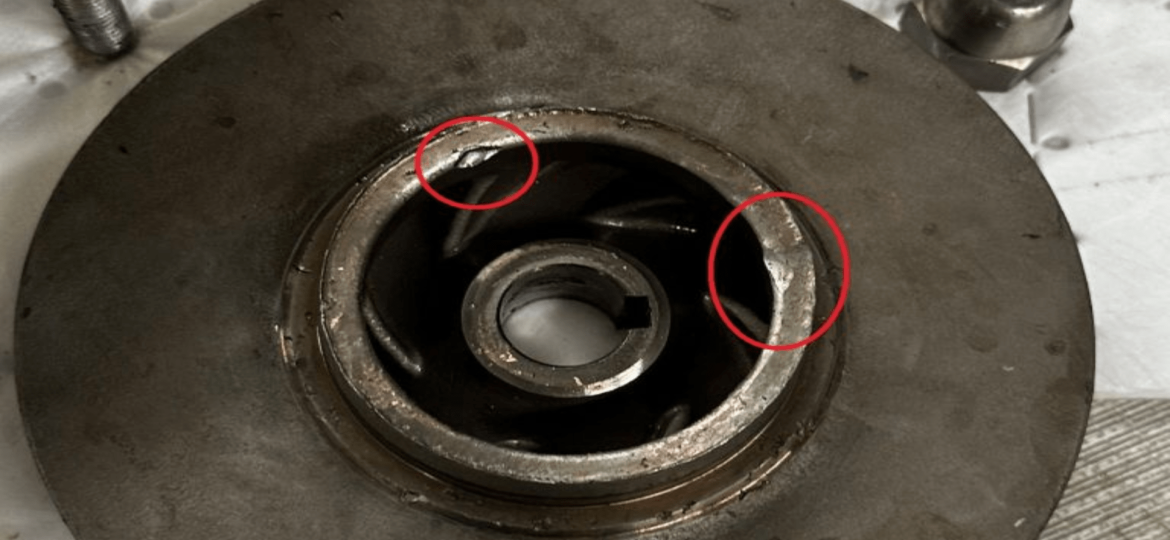
Alongside these essential analyses, visual inspection of impellers and internal components is crucial: hammered surfaces, erosion craters, pitting, and geometric irregularities on impeller blades are clear signs of active cavitation. A consistent monitoring and inspection program—supported by CDR Pompe’s technical expertise and advanced diagnostic tools—allows timely intervention to prevent cavitation from escalating into irreversible failures or costly production downtime.
PREVENTION STRATEGIES
As discussed, cavitation prevention requires integrated and consistent actions covering system design, pump selection, operations management, and maintenance.
First, accurate pumping system design is essential, including analysis of suction conditions, available NPSH, piping configuration, and appropriate material selection.
Second, pumps must be properly sized for the system: both oversizing and undersizing relative to the optimal working point increase cavitation risk.
Even with proper design and correct pump sizing, continuous monitoring of operating temperature and pressure remains crucial: high temperatures increase the fluid’s vapor pressure and therefore promote cavitation, while insufficient suction pressure can trigger it quickly.
A fourth key factor is preventive maintenance: clogged filters, sediment in the tank, damaged pipes, or malfunctioning valves increase pressure losses and consequently favor cavitation.
Finally, technical staff training is a strategic element: promptly recognizing cavitation signals allows corrective action before the phenomenon turns into a failure.
AT CDR, WE WORK WITH A PREVENTION-ORIENTED APPROACH
By relying on CDR Pompe’s expertise—from initial consulting to after-sales support, from kick-off meetings to scheduled predictive maintenance—operators can benefit from pumps designed to withstand the most demanding conditions, effectively monitor their systems, and prevent cavitation in a lasting way. With an integrated strategy, cavitation should not be considered an unavoidable risk, but rather a manageable and controllable phenomenon.
Contact us to learn more about our products, new solutions, and services, both in Italy and abroad.